Introduction to
Equations and Inequalities
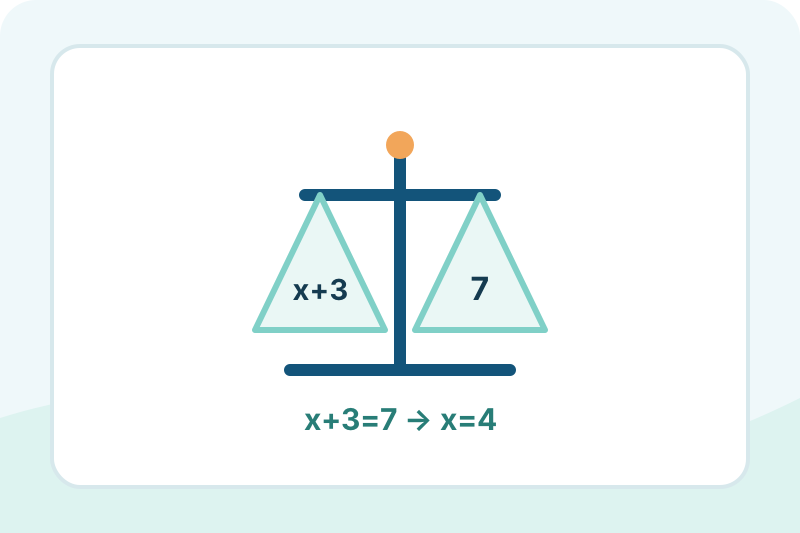
What is a linear equation?
A linear equation has the variable mostly in the first power only.
General form:
where \(a \ne 0\).
Examples:
The graph of a linear equation is a straight line.
Main rule
Whatever you do to one side, you must do to the other side.
You can:
- add/subtract both sides
- multiply/divide both sides
- combine like terms
- move variables to one side and constants to the other
Moving a term to the other side
When a term moves across the equal sign, its sign changes. A positive term becomes negative, and a negative term becomes positive.
Move \(+7\) to the right side. It becomes \(-7\).
Another quick example:
Linear Equation Example 1
Solve:
Step 1: Subtract 5 from both sides.
Step 2: Divide both sides by 2.
Answer:
Check:
Correct.
Linear Equation Example 2
Solve:
Step 1: Move \(x\) to the left side.
Step 2: Add 4 to both sides.
Step 3: Divide by 2.
Answer:
Check:
Left side:
Right side:
Correct.
Linear Equation Example 3
Solve:
Step 1: Subtract 5.
Step 2: Multiply both sides by 3.
Answer:
Check:
Correct.
Linear Equations
A linear equation with one variable has the form:
where a, b, c are constants and x is the unknown variable.
2x = 3y − 5 − 5 → 2x = 3y − 10
When a term crosses the equals sign, its operation flips:
Multi-step: (2x + 5) / 3 = 7
- 1Multiply both sides by 3: 2x + 5 = 21
- 2Subtract 5: 2x = 16
- 3Divide by 2: x = 8
· Simplifies to x = x → infinitely many solutions
· False equality (e.g. 8 = 3) → no solution
What is a quadratic equation?
A quadratic equation has \(x^2\) as the highest power.
General form:
where \(a \ne 0\).
Examples:
The graph of a quadratic equation is a parabola.
The solutions of a quadratic equation are the \(x\)-values where the parabola crosses the \(x\)-axis.
Main methods for solving quadratic equations
There are three common methods:
- Factoring
- Square root method
- Quadratic formula
Quadratic Equation Example 1 — Factoring
Solve:
We need two numbers that:
- multiply to 6
- add to \(-5\)
Those numbers are \(-2\) and \(-3\).
So:
Now solve:
If two factors multiply to zero, at least one of them must be zero.
So:
or
Answer:
Check with \(x = 2\):
Check with \(x = 3\):
Correct.
Quadratic Equation Example 2 — Square Root Method
Solve:
Take the square root of both sides.
Important: when solving \(x^2 = a\), we take both positive and negative roots.
Answer:
Why both?
Because:
and
Quadratic Equation Example 3 — Quadratic Formula
Solve:
Here:
Use the quadratic formula:
Substitute:
Simplify inside the square root:
Now split into two answers.
First:
Second:
Answer:
Quadratic Equations
A quadratic equation has the form:
Discriminant: D = b² − 4ac
Method 1 — Factoring
Find two numbers: multiply to c, add to b (when a = 1).
(x − 2)(x − 3) = 0 → x = 2 or x = 3
Method 2 — Quadratic Formula
D = 9 + 40 = 49
x = (3 ± 7) / 4 → x = 2.5 or x = −1
What is a linear inequality?
A linear inequality is like a linear equation, but with inequality signs.
General forms:
Example:
Very important rule
When you multiply or divide both sides by a negative number, you must flip the inequality sign.
For example:
Divide by \(-2\), and flip \(\lt\) to \(\gt\):
This is one of the most important inequality rules.
Change the sign and values. The blue shadow shows all \(x\)-values that make the inequality true.
Linear Inequality Example 1
Solve:
Step 1: Subtract 5.
Step 2: Divide by 2.
Answer:
This means every number less than 6 works.
Examples that work:
Check with \(x = 5\):
Correct.
Linear Inequality Example 2 — Negative Coefficient
Solve:
Step 1: Subtract 4.
Step 2: Divide by \(-3\).
Because we divide by a negative number, flip the sign:
Answer:
Check with \(x = -5\):
Correct.
Check with \(x = 0\):
False.
So \(x \le -4\) makes sense.
Linear Inequality Example 3 — Variables on Both Sides
Solve:
Step 1: Move \(2x\) to the left.
Step 2: Add 7.
Step 3: Divide by 3.
Answer:
Check with \(x = 4\):
Left side:
Right side:
Correct.
Linear Inequalities
Same as linear equations but uses >, <, ≥, ≤ instead of =.
What is a quadratic inequality?
A quadratic inequality has \(x^2\) and an inequality sign.
Examples:
A quadratic inequality asks:
The graph is a parabola.
Change the sign and values. The blue shadow shows the solution intervals.
The main strategy:
- Move everything to one side.
- Set the expression equal to zero.
- Solve the quadratic equation.
- Use the roots to divide the number line into intervals.
- Test each interval.
- Choose the interval that satisfies the inequality.
Key idea: roots split the number line
Suppose:
The roots are:
These divide the number line into three intervals:
Then we test each interval.
Quadratic Inequality Example 1
Solve:
Step 1: Factor.
So:
Step 2: Find roots.
Step 3: Split number line.
Step 4: Test each interval.
Interval 1: \(x \lt 2\)
Choose \(x = 0\).
Positive. So this interval works.
Interval 2: \(2 \lt x \lt 3\)
Choose \(x = 2.5\).
Negative. Does not work.
Interval 3: \(x \gt 3\)
Choose \(x = 4\).
Positive. Works.
Answer:
Interval notation:
Important: because the inequality is \(\gt 0\), not \(\ge 0\), we do not include 2 and 3.
Quadratic Inequality Example 2
Solve:
Step 1: Factor.
So:
Step 2: Find roots.
Step 3: Split number line.
Step 4: Test each interval.
Interval 1: \(x \lt -2\)
Choose \(x = -3\).
Positive. We need \(\le 0\), so it does not work.
Interval 2: \(-2 \lt x \lt 2\)
Choose \(x = 0\).
Negative. This works.
Interval 3: \(x \gt 2\)
Choose \(x = 3\).
Positive. Does not work.
Step 5: Include endpoints?
The inequality is:
So yes, include the roots \(-2\) and \(2\), because at those points the expression equals zero.
Answer:
Interval notation:
Quadratic Inequality Example 3
Solve:
Step 1: Factor.
So:
Step 2: Find roots.
and:
Step 3: Split number line.
Step 4: Test intervals.
Interval 1: \(x \lt -2\)
Choose \(x = -3\).
Positive. Works.
Interval 2: \(-2 \lt x \lt \dfrac{1}{2}\)
Choose \(x = 0\).
Negative. Does not work.
Interval 3: \(x \gt \dfrac{1}{2}\)
Choose \(x = 1\).
Positive. Works.
Step 5: Include endpoints?
The inequality is:
So yes, include the roots.
Answer:
Interval notation:
Quadratic Inequalities
Form: ax² + bx + c > 0 (or <, ≥, ≤)
- 1Rearrange so one side equals 0
- 2Solve ax² + bx + c = 0 → find roots x₁ and x₂
- 3Test a point in each interval to find the sign (+/−)
- 4Select intervals matching the inequality; include endpoints for ≥ or ≤
Case 1 — x² − 5x + 6 > 0
- 1Roots: (x − 2)(x − 3) = 0 → x = 2, x = 3
- 2Test each interval:
| Interval | Test point | Sign |
|---|---|---|
| x < 2 | x = 1 | + positive ✓ |
| 2 < x < 3 | x = 2.5 | − negative ✗ |
| x > 3 | x = 4 | + positive ✓ |

Case 2 — x² − 4x + 3 ≤ 0
- 1Roots: (x − 1)(x − 3) = 0 → x = 1, x = 3
- 2Test each interval:
| Interval | Test point | Sign |
|---|---|---|
| x < 1 | x = 0 | + positive |
| 1 < x < 3 | x = 2 | − negative ✓ |
| x > 3 | x = 4 | + positive |


Big difference between equations and inequalities
Equation
Example:
Answer:
An equation usually gives exact values.
Inequality
Example:
Answer:
An inequality usually gives ranges of values.
Linear vs Quadratic: Main Pattern
| Type | Form | Number of solutions |
|---|---|---|
| Linear equation | \(ax + b = 0\) | usually one solution |
| Quadratic equation | \(ax^2 + bx + c = 0\) | usually two, one, or no real solutions |
| Linear inequality | \(ax + b \gt 0\) | usually one interval |
| Quadratic inequality | \(ax^2 + bx + c \gt 0\) | usually one or two intervals |
Very important SAT-style tricks
1. For linear equations, isolate \(x\)
Example:
Add 9:
Divide by 4:
Fast.
2. For quadratic equations, first try factoring
Example:
Ask:
Answer:
So:
3. For quadratic inequalities, use sign chart
Example:
Roots:
A product of two factors is negative when the signs are different.
That happens between the roots:
Quick summary
Linear equation
Solution:
Quadratic equation
Solution:
Linear inequality
Solution:
Quadratic inequality
Solution:
The main mental model:
Inequalities ask: “Where is it bigger or smaller?”
Conclusion & Similarities
All four topics ask the same first question: what values of x make the statement true?