Module 1 — Introduction to Planimetry

Types of Triangles

Triangles can be grouped by their sides and by their angles. This lesson focuses on three very important families: right triangles, equilateral triangles, and isosceles triangles.

Main idea: A triangle's side lengths and angle measures tell us which special properties and formulas we can use.

What you will learn

  • How to recognize right triangles
  • Why equilateral triangles have three \(60^\circ\) angles
  • Why isosceles triangles have equal base angles
  • How perimeter, area, and height formulas connect

1Right Triangles

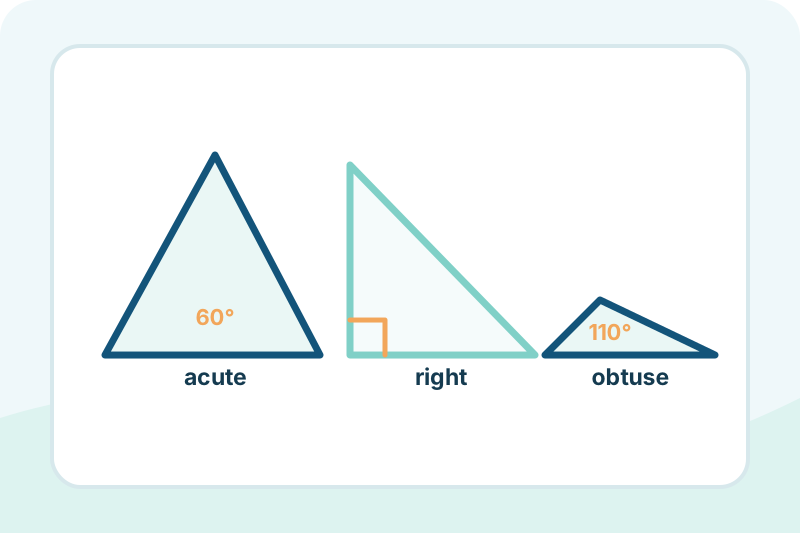
A right triangle is a triangle in which one angle is exactly \(90^\circ\). The other two angles are acute, so each is less than \(90^\circ\).

Sides of a right triangle

  • Hypotenuse: the longest side, opposite the right angle.
  • Legs: the two sides that form the right angle.

Angle property

The two acute angles are complementary.

\[90^\circ+\alpha+\beta=180^\circ\]
\[\alpha+\beta=90^\circ\]

2Main Formulas

Pythagorean Theorem

If the legs are \(a\) and \(b\), and the hypotenuse is \(c\), then:

\[a^2+b^2=c^2\]

Example: if \(a=6\) and \(b=8\), then \(c=\sqrt{6^2+8^2}=10\).

Perimeter and area

\[P=a+b+c\]
\[A=\frac12ab\]

The area formula uses the legs because they are perpendicular.

Trigonometric ratios

For an acute angle \(\theta\), the basic ratios are:

\[\sin\theta=\frac{\text{opposite}}{\text{hypotenuse}},\quad \cos\theta=\frac{\text{adjacent}}{\text{hypotenuse}},\quad \tan\theta=\frac{\text{opposite}}{\text{adjacent}}\]
Special right triangles: A \(45^\circ-45^\circ-90^\circ\) triangle has side ratio \(1:1:\sqrt2\). A \(30^\circ-60^\circ-90^\circ\) triangle has side ratio \(1:\sqrt3:2\).

3Right Triangle Calculator

Hypotenuse10
Area24
Perimeter24
Acute angles37°, 53°

1Equilateral Triangles

An equilateral triangle is a triangle in which all three sides are equal in length. Because the sides are equal, all three interior angles are also equal.

Sides and angles

  • All three sides are equal.
  • All three interior angles are \(60^\circ\).
  • Every equilateral triangle is also isosceles.

Angle property

\[60^\circ+60^\circ+60^\circ=180^\circ\]

All angles are equal and acute.

2Height, Perimeter, and Area

The altitude of an equilateral triangle splits it into two congruent right triangles and divides the base into two equal parts.

Height

\[h=\frac{\sqrt3}{2}a\]

If \(a=10\), then \(h=5\sqrt3\).

Perimeter and area

\[P=3a\]
\[A=\frac{\sqrt3}{4}a^2\]
Special property: In an equilateral triangle, the median, altitude, angle bisector, and perpendicular bisector from a vertex are the same line.

3Equilateral Triangle Calculator

Height6.93
Area27.71
Perimeter24
Angles60°, 60°, 60°

1Isosceles Triangles

An isosceles triangle is a triangle in which at least two sides are equal in length. The angles opposite the equal sides are also equal.

Parts of an isosceles triangle

  • The two equal sides are called legs.
  • The remaining side is called the base.
  • The angle between the equal sides is the vertex angle.

Angle property

The angles opposite the equal sides are equal. These are called the base angles.

2Symmetry, Perimeter, and Area

Altitude from the vertex

The altitude from the vertex to the base is special: it is perpendicular to the base, bisects the base, and bisects the vertex angle.

This creates two congruent right triangles.

Perimeter and area

\[P=2a+b\]
\[A=\frac12bh\]

If the height is unknown, use the Pythagorean Theorem on half of the base.

Example

If the equal sides are \(13\) and the base is \(10\), half of the base is \(5\). The height is:

\[h=\sqrt{13^2-5^2}=\sqrt{169-25}=12\]
\[A=\frac12(10)(12)=60\]

3Isosceles Triangle Calculator

Height12
Area60
Perimeter36
Base angles67°, 67°

4Quick Comparison

Right triangle: one angle is \(90^\circ\), so the Pythagorean Theorem applies.
Equilateral triangle: all sides are equal and all angles are \(60^\circ\).
Isosceles triangle: at least two sides are equal and the base angles are equal.